
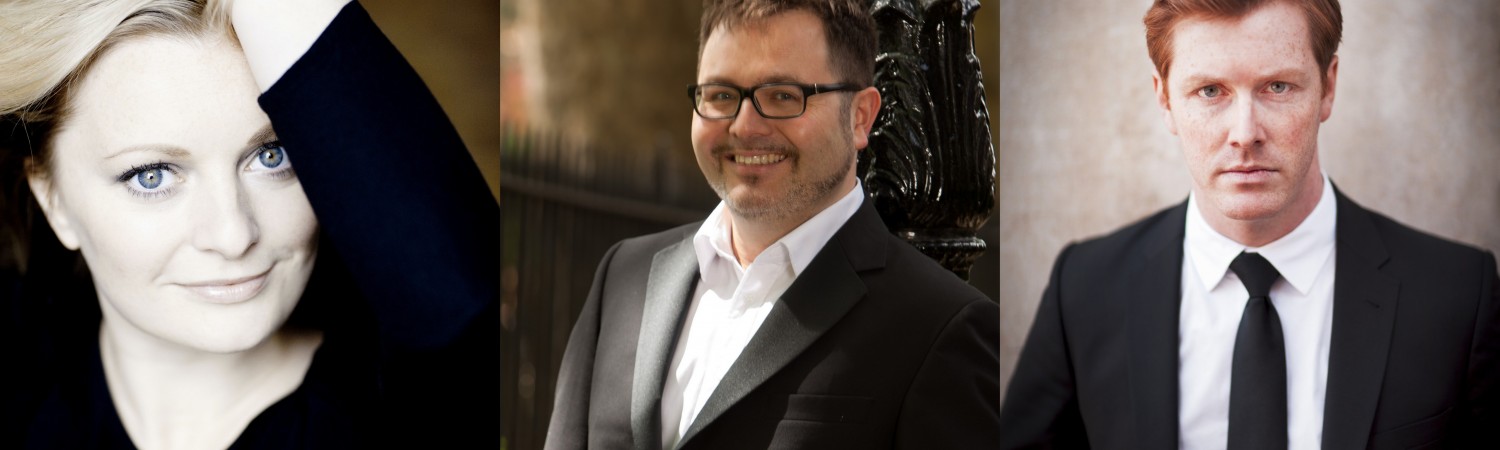
We’re enormously proud to be opening the London Festival of Baroque Music this year on Friday 12 May with the extraordinary talents of soprano Lucy Crowe and counter-tenor Tim Mead.
The Festival recently quizzed these vocal virtuosi on their experiences of singing together previously and what else makes them tick.
Hear them both perform Pergolesi‘s tortured but exquisite Stabat Mater, conducted by EOC director Christian Curnyn, on Friday 12 May at St John’s Smith Square. A limited number of tickets are available via the Box Office 020 7222 1061 or here .
The two of you have performed the Pergolesi Stabat mater together before. What was the experience like?
Lucy: It was a wonderful concert conducted by our mutual friend, David Bates. David is my best friend so working with him is always a joy. I am a big fan of Tim’s voice so enjoy making music with him, shaping lines together in the duets and sitting back and listening to his glorious sound in his arias!
Tim: I remember it as being a particularly beautiful one. It’s always hard to know exactly how two voices will work together, especially voices that seem as different as Lucy’s and mine. But I think it’s the difference that makes it interesting. We’re not striving to sing with the same voice, but rather use the different elements of our sounds to interact with each other as well as provide a fuller vocal landscape when the voices join. We also seem to have a natural musical chemistry, which allows for plenty of spontaneity with details of phrasing and expression in the pressurised environment of live performance.What are the special joys and challenges of singing this piece, and how do you prepare for it?
Tim: My biggest challenge with this piece is that I almost love it too much. I remember it making an immediate impression on me when I bought the Andreas Scholl/Barbara Bonney recording as a student, and its strong appeal hasn’t diminished in the years since. It’s hard to strike the right balance between the unavoidable desire to luxuriate in this glorious music and concentrating on all the things you need to do as a singer to do it justice.
Lucy: I prepare for it like any other piece; it’s when you get together with the other forces that the work really starts. Balancing the voices, working out musically where the climaxes are and how to blend the voices appropriately to gain the best sound etc. Being able to take the vibrato out of your sound to create a different colour and sound world is always an enjoyable thing to do in Baroque music.Have there been any other memorable occasions when the two of you have performed together?
Tim: There was an unfortunate incident at English National Opera many years ago when we ended up sharing a see-through pink PVC dress… but touring and recording Messiah together with Emmanuelle Haïm is probably memorable for more of the right reasons!
Lucy: We performed The Coronation of Poppea together at English National Opera in 2007. We had to wear rather quirky outfits and I remember us giggling a lot feeling pretty ridiculous in our see-through pink plastic and bright sparkly silver costumes.What first got you started as a singer?
Lucy: I really loved singing along to my mum’s CDs from a young age…Maria Callas’s greatest hits, Handel’s Messiah and the soundtrack to Blood Brothers. I sang in the school choir and my music teacher told me I should get my voice trained, so I started having singing lessons at the age of ten.
Tim: Like many British singers, I started off in a cathedral choir at the age of seven and have been singing ever since.And what made you decide to make singing your career?
Lucy: It was just what I always wanted to do. I loved being able to express myself with my voice and it became obvious to me that this was my natural path. Sometime in my mid-teens I remember my parents asking me ‘are you sure this is what you want, because if it is we will support you 100%.’
Tim: It was never a conscious decision. A chance meeting with an agent when I was 19 steered me towards music college after my undergrad. I went because they offered me a scholarship and I hadn’t really thought of another plan! I was thrown onto the professional opera stage fairly quickly after that and it took a few years in the job before it dawned on me that singing was something I really wanted to do.Do you also play any instruments?
Tim: I was a cellist at school and briefly considered pursuing it as a career, but am fairly sure I wasn’t good enough. I’ve also studied the piano, oboe and recorders.
Lucy: I used to play the flute pretty well, I play the piano pretty badly, and I used to own a drum kit in my teens and drum along and rock out to Guns and Roses and Metallica!Who are your favourite composers, Baroque or non-Baroque?
Tim: In the Baroque I’m always drawn towards composers such as Monteverdi and Cavalli for the way they create beauty and drama whilst being the total servants of the text. More recently I find myself falling in love with Purcell again. In the non-Baroque I’ve always had a soft spot for Debussy, a fascination with Shostakovich, and will forever be in awe of George Benjamin’s intricate beauty.
Lucy: It would be a very long list if I wrote all of them, so I’ll pick a few, in no particular order: Handel, Mozart, Bach, Verdi, Strauss, Schubert, Mahler. To be honest I fall in love with everything I sing!And who are your favourite non-classical musicians?
Lucy: London Grammar, Aurora, Fleetwood Mac, Coldplay, Genesis, Foals, Kings of Convenience, Nick Drake, Stereolab, Anita Baker …
Tim: I’ve never had much of an interest in non-classical music.If you weren’t a musician what would you most like to be?
Lucy: I think about this a lot, especially now since my work often takes me away from my home and family. I never really considered doing anything else when I was younger but now I wonder what else I could have been good at. I’m fascinated by the human mind and body, and recently finished reading Fragile lives by Professor Stephen Westaby. A heart surgeon’s stories of life and death on the operating table. So maybe something in medicine. I also love seeing animals in their natural habitat – I’ve seen the gorillas in Uganda, leatherback turtles laying their eggs in Trinidad, humpback whales in Oz… so maybe something animal related…
Tim: Definitely something creative. Maybe an actor or director.Which famous person (living or dead) would you most like to meet?
Tim: A slightly obvious musical answer, J S Bach. Of all the music I sing, Bach leaves me with more questions than anyone else.
Lucy: I met him two years ago …. Sir David Attenborough, I sat next to him at a dinner at Buckingham Palace. We didn’t stop talking all evening. He was so funny, entertaining and charming with a real twinkle in his eye.What do you like to do when you’re not making music?
Tim: I love movies and see most new releases in the cinema when I can, as well as popping down to the BFI for more classic films. I also try to get to as much theatre as possible when I’m back in London.
Lucy: Spending quality time with my gorgeous children, husband and friends. Cooking and baking, reading, helping my husband on the allotment!What was the last book you read that you really liked?
Lucy: When Breath becomes air by Paul Kalanithi. A deeply moving and immensely powerful memoir of a highly intelligent and talented neurosurgeon, who at 36 was diagnosed with inoperable lung cancer. One day he was a doctor treating the dying, the next he was a patient struggling to live. It is a profound reflection on the meaning of life and helped put my own life in perspective when I was miserable missing my family whilst working abroad.
Tim: Daisy Miller by Henry James
Lucy Crowe and Tim Mead perform Pergolesi’s Stabat mater with the orchestra of the Early Opera Company conducted by Christian Curnyn in a concert that also includes radical orchestral works by WF and CPE Bach on Friday 12 May at 7.30pm. For tickets, please visit the London Festival of Baroque Music website.


